Business · Market launch
Launch nationally, or stage the rollout?
Test demand, adoption, capacity and competitor reactions before full commitment.
Value added Cash exposure by pathway, a staged rollout and clear scale-or-stop signals.
Business · public policy · ecology
Stress-test tomorrow
before it becomes expensive.
Before you commit capital, launch a policy or alter a living system, we simulate how people, institutions, markets and environments could respond—so you can compare options, expose failure modes and act with clearer conditions.
Decision support, not prediction. Every result shows its assumptions, uncertainty and limits.
01Test without an account or personal questions.
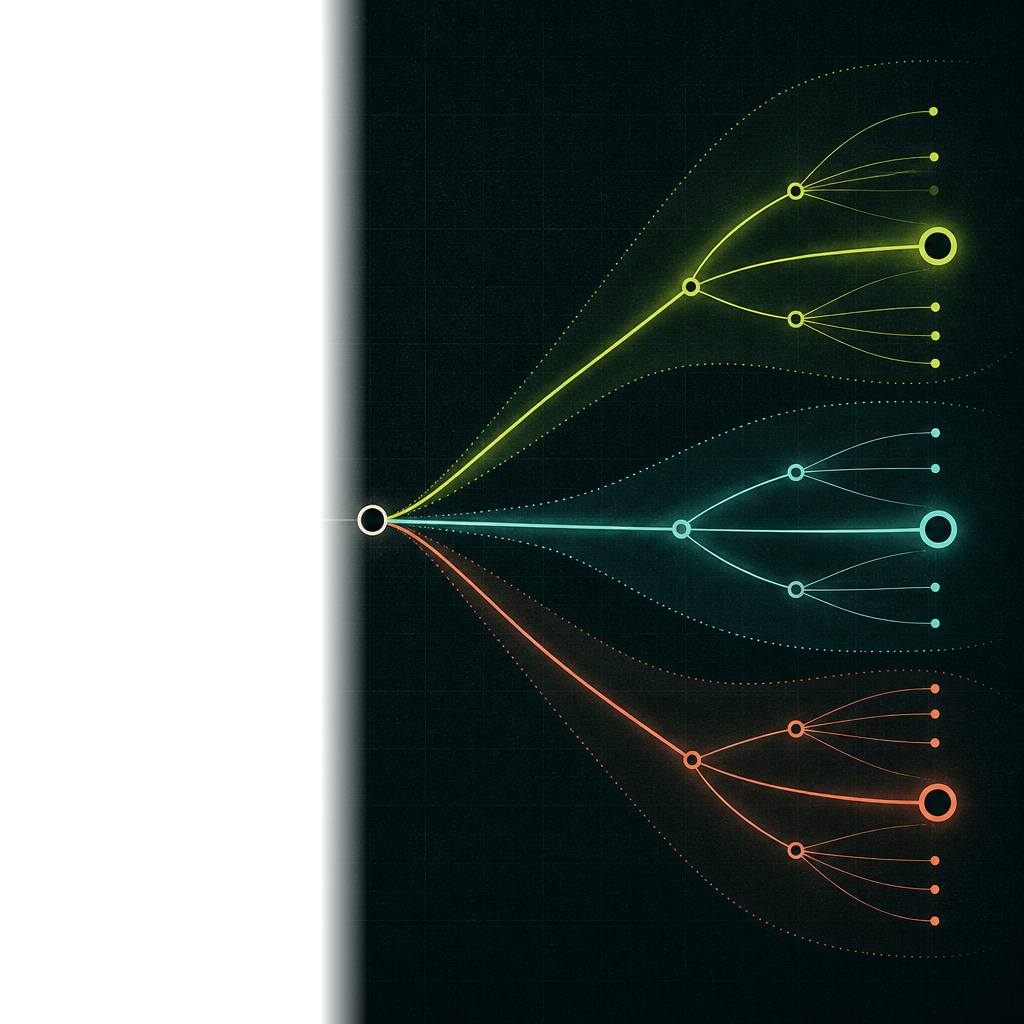
02Compare three moves across matched test worlds.
03See ranges, failure conditions and limits.
Three places it adds value
Every study starts with one decision and several plausible responses. These examples are illustrative—not claimed client results.
Business · Market launch
Test demand, adoption, capacity and competitor reactions before full commitment.
Value added Cash exposure by pathway, a staged rollout and clear scale-or-stop signals.
Public policy · Access
Model trust, access, social influence and unintended incentives before a policy is fully launched.
Value added Earlier visibility of who may be missed, why uptake stalls and when the design needs adjustment.
Ecology · Water
Simulate households, farms, utilities and ecological flows under compound stress.
Value added Visible trade-offs, protection thresholds and early warnings before options narrow.
How it works
We use the lightest credible model for the question. Complexity must earn its place by improving the decision.
Define the decision, options, owner, horizon, success and consequences of being wrong.
Map actors, incentives, behavioural distributions and feedbacks. Add bounded AI agents only where context matters.
Run many futures; challenge code, evidence, assumptions, sensitivity and alternative structures.
Identify robust and conditional options, failure conditions, leading indicators and reversible steps.
Typical outputs
Ways to work
Scope, evidence, validation standard and acceptance criteria are agreed before work begins.
For an urgent decision: frame the system, prototype focused options and expose the uncertainties worth resolving first.
Scope a sprint →For a material investment, policy or transition: build a simulation with calibration and validation proportionate to the available evidence.
Build a decision model →For recurring choices: refresh evidence, rerun scenarios, monitor triggers and transfer capability to your team.
Discuss a living lab →Verification, sensitivity, assumption, bias and governance review—with prioritized remediation.
Rigor you can audit
A simulation is evidence about the consequences of assumptions—not evidence sent back from the future. We document provenance, compare simpler alternatives and keep accountable humans at every gate.
Synthetic agents are modelling instruments. They do not replace evidence, consent or participation with real people.
Explore validation and governance →Every finding is labelled
No. We make conditions and options explicit across several plausible futures, then identify choices that remain useful when assumptions change.
We begin with the decision, not the data warehouse. Stronger quantitative claims require stronger evidence and validation.
It can, subject to an agreed architecture and security review. Projects can be designed for isolated, private-cloud, on-premise or sovereign execution with agreed access and retention controls.
Your next move
Tell us what must be decided, by when and what failure would cost. We will tell you whether simulation is useful and propose the smallest credible study that could improve the choice.
Discuss a decisionInitial fit review · no files, secrets, order or payment.